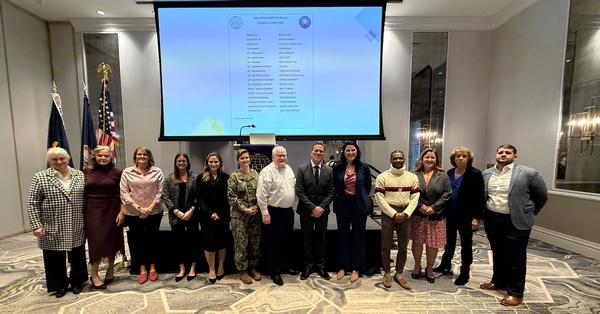
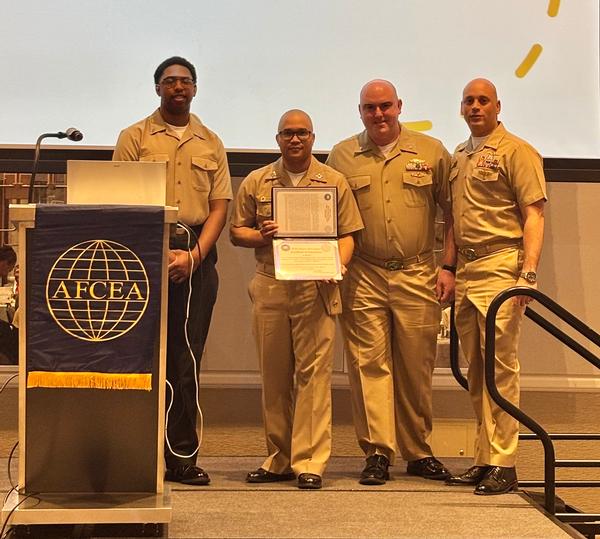
The chapter kicked off 2026 with the swearing in of new and returning board of directors:
Kelly Jenne, chapter president
Kailey Cornick, chapter executive vice president
Danielle Thomasson, chapter secretary
Zeib Parvez, chapter treasurer
Eric Johnson, chapter vice president of programs
Eric Davis, chapter vice president of education
Beth Armistead, chapter vice president of awards
Faith Brent, chapter vice president of communications
Rebecca Newberry, chapter vice president of membership
Capt. Brett O'Donovan, chapter vice president of military affairs
Caitlin Johnson, chapter vice president of Maritime IT Summit
Danna Kassis, chapter vice president of Emerging Leaders
Amy Yendell, chapter chair of small business
Teresa Duvall*, chapter chair of special programs
Neil Bourassa*, chapter historian
Larry Minnick*, special activities, golf
Caitlin Johnson, immediate past chapter president
Matthew Umphlet, webmaster
*denotes past president
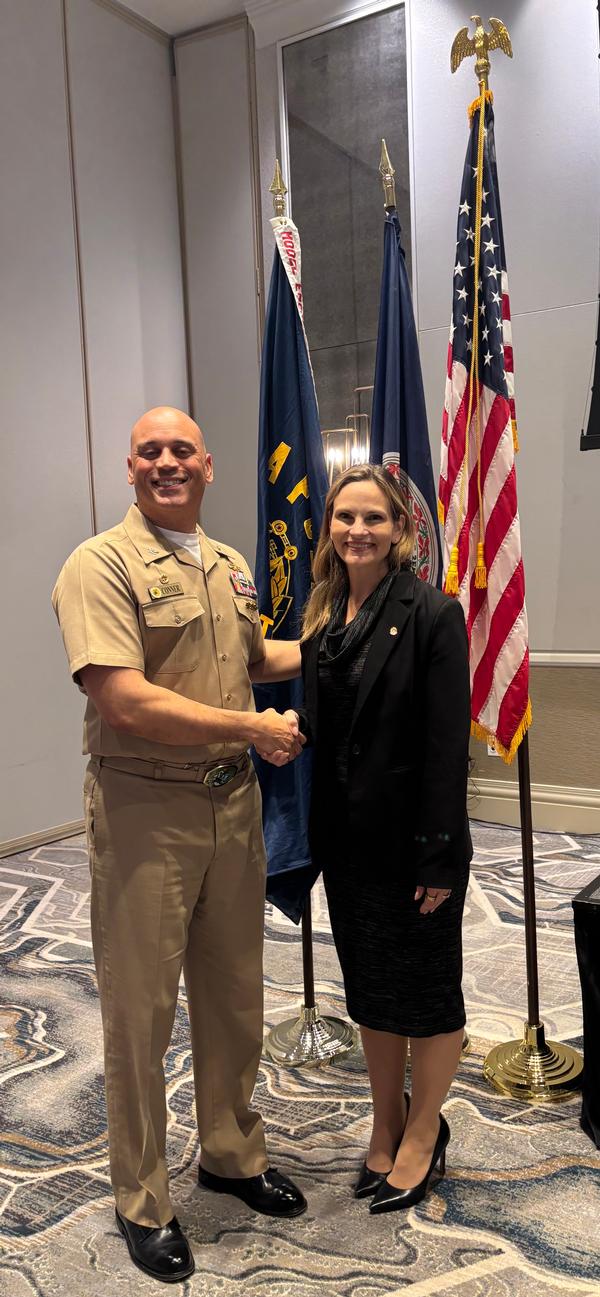
Following the board swearing-in, the chapter welcomed Capt. Brian Conner, USN, commanding officer of Naval Computer and Telecommunications Area Master Station Atlantic (NCTAMS LANT), who discussed the Navy's evolving approach to enterprise transport and its role in enabling operational success worldwide.
Conner emphasized that while the Navy's mission has not changed, the operating environment has grown increasingly complex. Today's forces must project power forward-often far from home-under contested and degraded conditions. Using a sports analogy, he described the importance of "away games," where success requires preparation, resilience and trust.
"Winning the away game requires trust in your team," he noted-confidence that people, systems and networks will perform when it matters most.
That trust depends on delivering reliable information to the right people at speed, even in the most challenging conditions. The warfighter must remain focused on the fight, not the network or communications. Regardless of the environment, the network should adapt automatically and function seamlessly without sailor intervention.
Future networks must include meshed architecture, redundancy, plug-and-play capability and the ability to absorb disruption. These attributes ensure assured command and control and enable timely, confident decision-making. The objective is clear: warfighters must never be disconnected, and decision advantage must be preserved.
Conner highlighted the growing need for artificial intelligence to deliver cloud computing at speed and scale, supporting rapid analysis and informed decisions. He stressed that enterprise transport must be treated as a day-one requirement-built, bought and created as a foundational capability, not an afterthought.
A key focus of the discussion was NCTAMS LANT's mission. He emphasized that the command is far more than a communications provider-it is a critical cyber asset enabling the Navy's decision advantage. Through five core mission areas, NCTAMS LANT delivers secure, resilient connectivity across the fleet, captured in its slogan: "Wired up, fired up."
The luncheon concluded with a clear message: while the Navy's mission remains constant, future success, especially in demanding "away games," will depend on trusted teams, adaptive networks and enterprise transport that delivers decisions at speed, wherever the fight requires.
|