Despite a lapse in federal funding last fall, continued budget uncertainty this year and even a surprise snowstorm after a week of springlike temperatures, the chapter proved that resilience extends beyond the battlefield! The chapter successfully convened government and industry leaders for its annual Naval IT Day in March, centered on the theme, Enabling the Naval Force: Data, Digital, and Decision Advantage.
The event brought together U.S. Navy and Marine Corps technology leaders to discuss how digital transformation, resilient networks and data-driven decision-making are shaping the future of naval operations. Thank you to Ryan Cox and his team on the AFCEA NOVA Naval IT Day Planning Committee.
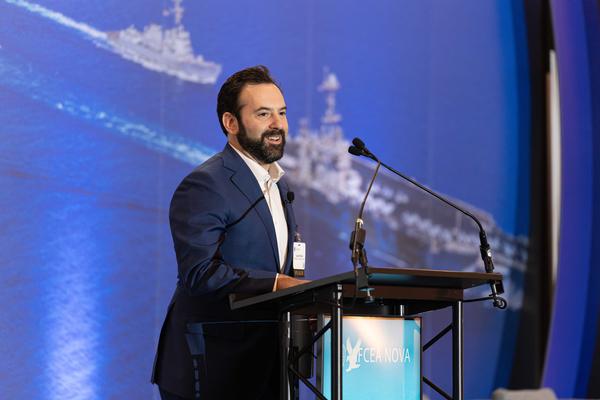
Louis Koplin, program executive officer for Program Executive Office (PEO) Digital at the U.S. Department of the Navy, opened the morning keynote with a discussion of the OV-1 operational concept, emphasizing the importance of aligning technology modernization with mission outcomes. He wants to debunk the myth that modernization can't be done. Koplin pointed to trends such as software-defined capabilities, balancing speed with operational rigor and the critical role of zero-trust architectures as the foundation for enabling secure, data-driven decision-making.
Expanding on that vision, Richard Cunningham, director of Naval Enterprise Networks within PEO Digital, discussed how the Navy is evolving its enterprise networks to support the fleet in 2026 and beyond. He emphasized the importance of delivering reliable, secure connectivity from shore to sea and that the network itself must now be viewed as a warfighting capability.
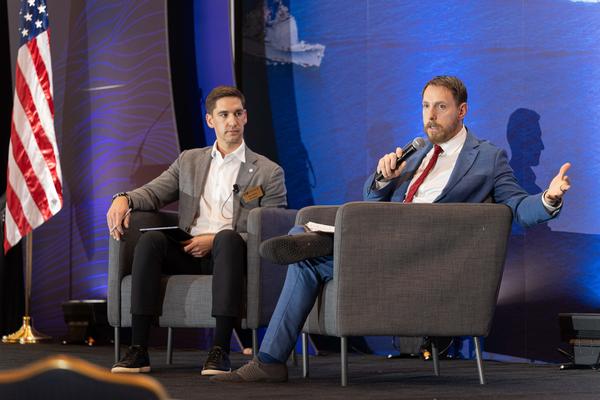
The luncheon keynote and fireside chat with Colin Crosby, deputy commandant for information and service data officer for the U.S. Marine Corps, highlighted the growing importance of data in modern warfare. Data must be visible, accessible, linked, trustworthy, interoperable and secure. And the Marines are hungry for your expertise and technology.
A subsequent panel on achieving mission success through digital, cyber and decision advantage featured Anne Marie Schumann, the Department of the Navy's principal cyber advisor, alongside Dave Raley, chief digital business officer for Operation StormBreaker with the Marine Corps.
Speakers emphasized that cybersecurity must be integrated from the start of development rather than added later. By embedding security guardrails directly into development pipelines, teams can receive immediate feedback and build resilient systems faster.
The end of the day featured acquisition and innovation discussion with Andrew Magliochetti, director of Small Business programs for the Office of the Secretary of the Navy, and Jared Kaib, technical director for the Navy's Rapid Capabilities Office. And the event closed out with Justin Fanelli, chief technology officer for the Department of the Navy.
Throughout the discussions, one message remained consistent: data is foundational to modern naval operations. By strengthening networks, embedding cybersecurity and enabling faster decisions at the edge, the naval services are working to ensure the force maintains a decisive advantage in an increasingly complex battlespace.
|


.jpg)

